what happens to a cells water when the exterior liquid is saltier than its interior?
Osmosis Lab
Introduction: Human blood, at 0.9% salt concentration, is a little less salty than seawater, which has a salt concentration of about 35 parts per thou (3.five%). If we take seawater as an case of a solution, the common salt is called the solute (the particles that are dissolved) and the water is the solvent (the liquid that dissolves the particles). Osmosis is the move of a solvent beyond a semi-permeable membrane from an area of lower solute concentration to an area of higher solute concentration. The water (the solvent) can motion beyond the membrane only the dissolved solutes (the sodium and chloride ions that grade salt) cannot. In such situations, h2o volition move across the membrane to residual the concentration of the solutes on both sides. Cells tend to lose water (their solvent) in hypertonic environments (where there are more solutes exterior than inside the cell) and gain water in hypotonic environments (where there are fewer solutes outside than inside the jail cell). When solute concentrations are the aforementioned on both sides of the cell, at that place is no net h2o movement, and the cell is said to be in an isotonic environment. In this lab we will test samples of white potato tissue to see how much water they blot or release in salt solutions of varying concentrations. This gives united states an indirect way to measure the osmotic concentration within living cells.
Hypo=under, iso=equal, hyper=over
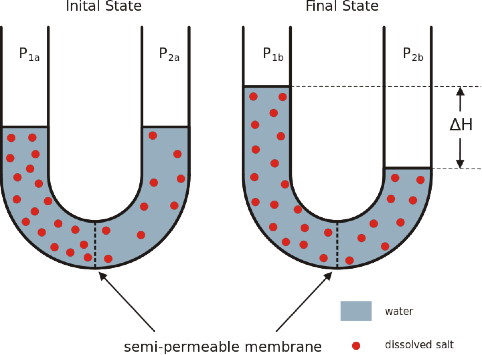
Compare initial and final states. Which way did the water move? Why?
- electronic balance (0.01 g range)
- metric ruler with mm calibration
- metric measuring cups
- half dozen cereal bowls or shallow pans
- a minor piece of raw irish potato to cut into six ~5 mm cubes
 (this square is 5 10 5 mm)
 - single edged razor or knife
- paper towels
- sentry or clock
- tabular array salt, distilled or tap water
- 6 beakers (250 ml or larger) or cups
Methods:
- Pre-mix 6 beakers of salt solutions (0%, 0.1%, 0.5%, 1%, two.five%, 5%) in distilled water. Yous can use this solution calculator to help you make your solutions. Just enter the water volume of your container and the percentage of salt yous desire and it volition tell you how many grams of salt to add together. A ane% common salt solution is 1 part table salt to 100 parts h2o. To make a 1% salt solution, y'all could utilise a 100 ml bottle, add together exactly ane gram of salt (use your electronic balance) to your bottle, and bring the water book up to 100 ml. To make a 0.one% solution, add i gram of common salt to grand ml of h2o (or add 0.one k salt to 100 ml of water). If you lot take more water than you demand, only stir well and and then discard the excess.
- Set up six small potato cubes with no skin that are all about equal in size (approximately 5 millimeters in length, width and height) and absorb them dry on a paper towel. (Blot means simply gently remove the surface water; no need to squeeze them!)
- Mass (weigh) each to the nearest 0.01 grams, keeping them separate, and record each initial mass in Tabular array 1. Don't wait likewise long before putting them into the solutions, as evaporation will occur.
- Make full each bowl with i of the 6 stock solutions, keeping track of which is which! Label them. You won't exist able to tell the salinity only by looking. Notation which potato slice went into which bowl.
- Leave one of the potato slices in each of the salt solutions for upwardly to 24 hours then that they may gain (or lose) water past osmosis. (Keep them all in the table salt h2o the aforementioned amount of time--leaving them overnight is likely to give the best results).
- Remove the slices, blot them dry on a paper towel, carefully re-counterbalance them and record in the data table every bit final mass.
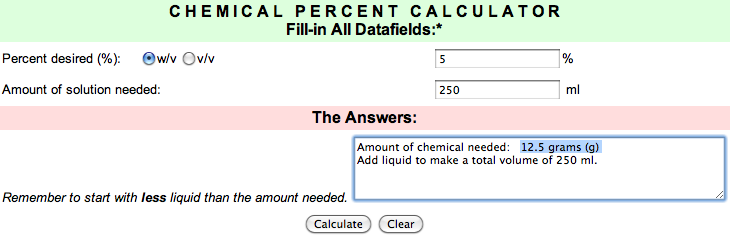
Click here to go to the calculator page, and thanks to the University of Oklahoma for this useful tool!
Results:
1. Record your actual results in a table like this one:
| | | | | |
| Sample 1 | 0.0% | |||
| Sample 2 | 0.ane% | |||
| Sample 3 | 0.5% | |||
| Sample iv | 1.0% | |||
| Sample 5 | two.v% | |||
| Sample 6 | v.0% |
Table 1: Changes in potato mass equally a result of immersion in salt solutions.
two. Prepare a graph showing change in mass as a role of % salt. Scale the ten-centrality of your graph in units of 0.5 percent. The y-axis has a zero line half fashion upwards, indicating whether the samples lost or gained weight. You lot volition have to scale the y-axis according to your greatest and smallest changes in mass. Download this  Excel spreadsheet if you demand help making a graph.
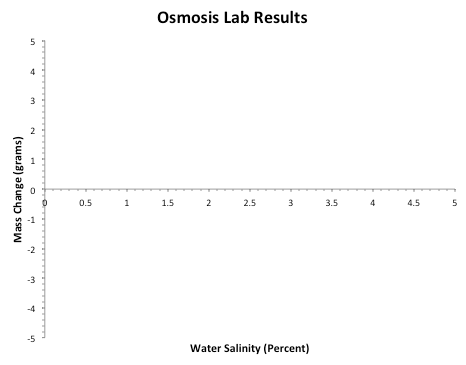
Effigy 1: Change in mass of potato (g) due to h2o gain/loss as a function of salt concentration.
3. When completed, utilise a ruler to depict a straight line of best fit through your vi data points, or use the computer to graph your data and summate the line of best fit. Where the line of all-time fit crosses the horizontal zero line, draw a vertical line down to the 10-axis. This is the bespeak at which the potato is isotonic with its surround, and is therefore the estimated salt concentration of the white potato.
Questions:
- Why did some white potato samples proceeds h2o and others lose h2o? Was there whatever blueprint?
- When you lot drew the all-time fit line through your data and dropped the vertical line to the ten-axis, what table salt concentration did you obtain (Guess if information technology is between numbers)? What does this mean for the potato?
- Why tin can't nosotros utilize seawater to irrigate our crops?
- What happens when a thirsty person drinks salt water to endeavor to quench their thirst?
- Why does salted popcorn dry out your lips?
- What happens to a cell's water when the exterior liquid is saltier than its interior?
- What happens to h2o outside the prison cell when the interior is saltier than its environs?
- When a cell gains water, what happens to its size and weight?
- When a jail cell loses h2o, what happens to its size and weight?
- When you put limp celery stalks in water, they firm upwardly. Why?
- Challenge question: Saltwater fish are hypotonic (less salty) to their surroundings while freshwater fish are hypertonic (more salty) to their surround. Assuming the salt can't move, what must each fish practice with its fluids in order to compensate for the deviation in salinity between the body and the surrounding environs?
montgomerydeall1956.blogspot.com
Source: https://www2.nau.edu/lrm22/lessons/osmosis/osmosis.html
0 Response to "what happens to a cells water when the exterior liquid is saltier than its interior?"
Post a Comment